The High-Touch Surfaces You Should Never Skip
The surfaces people touch most are the ones that spread germs fastest, and often the ones cleaners forget. Here is a complete checklist of high-touch points and how to clean them properly.
Why high-touch surfaces deserve special attention
A home can look clean and still be a place where germs travel freely from one person to the next. That happens because the things that spread illness are rarely the big, visible surfaces. They are the small points that many hands touch every single day: a light switch, a doorknob, a faucet handle. These are called high-touch surfaces, and they are the difference between a home that looks clean and a home that is genuinely healthier to live in.
For a professional cleaner, understanding high-touch surfaces is a mark of real skill. Anyone can wipe a counter. Knowing that the pull on the refrigerator door and the toggle on the light switch carry more germs than the counter itself is the kind of knowledge that clients notice and remember.
The reason is simple. When someone is sick, they cough into a hand and then open a door. The next person opens the same door and later rubs an eye. Cleaning the flat surfaces while skipping the handles leaves the fastest route for germs untouched. When you make high-touch points part of your routine, you break that chain.
What counts as high-touch
A high-touch surface is any point that hands, and sometimes faces, contact many times a day. They tend to be small, which is exactly why they get overlooked. A helpful habit is to walk through a home and ask yourself, if I were living here, what would I touch on the way from the front door to the kitchen to the bathroom to bed. Those points are your map.
They fall into a few groups, and the more you clean, the more automatic it becomes to hit every one.
Entry and doors
Start where people start. The front door area sees more traffic than almost anywhere else.
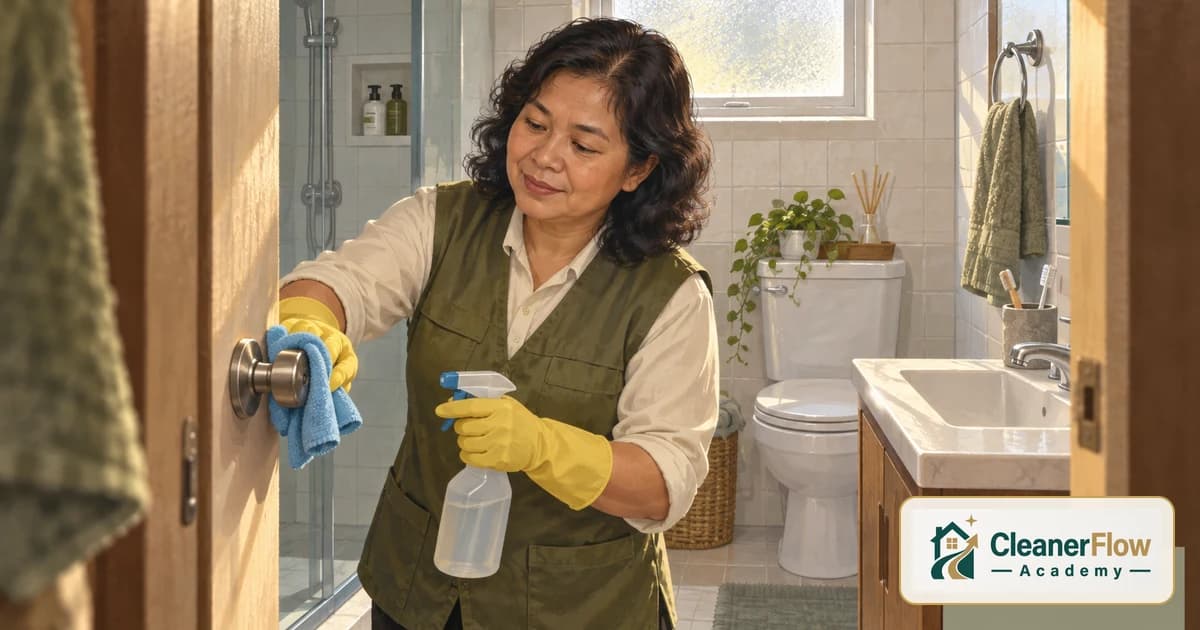
- Doorknobs and door handles, on both sides of every door, including interior doors people push open with a hand.
- Deadbolt latches and the small turn locks people flip on the way in and out.
- The doorbell button and any smart lock keypad.
- Light switches near the entry, which almost everyone touches within seconds of arriving.
Wipe these with a cloth dampened with an appropriate cleaner, and give metal handles a moment of contact time rather than a quick swipe. Germs need the product to sit briefly to be reduced.
Switches, controls, and handles throughout the home
These are the surfaces people touch without thinking, which is why they are so easy to skip.
- Every light switch and dimmer in the home. There are usually more than you expect.
- Thermostat panels and any wall-mounted controls.
- Cabinet and drawer pulls in the kitchen, bathroom, and bedrooms.
- Appliance handles: the refrigerator, oven, microwave, and dishwasher.
- Remote controls and gaming controllers, which pass between many hands and rarely get cleaned.
- Phone chargers, landline phones, and the handles of frequently used electronics.
Remote controls deserve a special mention. They are among the germiest objects in a home and are almost never cleaned by the owner. Wiping them down with a barely damp cloth, careful not to let moisture seep into the buttons, is a small touch that makes a real impression.
The kitchen
The kitchen combines high touch with food, which makes it a priority.
- Faucet handles and the faucet neck, touched with dirty hands during cooking.
- The refrigerator door handle and the handles of upper and lower cabinets around the prep area.
- The dish soap pump and the handle of the trash can lid, especially a step-pedal or a swing lid touched by hand.
- Countertop edges where people lean and rest their hands.
- The microwave keypad and oven controls.
Because the kitchen mixes germs with food surfaces, be mindful of your cloths here. Do not use the same cloth on the trash can lid and then on a food-prep counter. Keeping separate cloths, or rinsing thoroughly between zones, protects the family from cross-contamination.
The bathroom
The bathroom is where high-touch cleaning matters most for health.
- The toilet flush handle or button, one of the single germiest points in any home.
- Faucet handles on the sink.
- The toilet lid and seat, and the small area around them people touch when closing the lid.
- Cabinet and drawer pulls, the towel bar, and the toilet paper holder.
- Light switches and the door handle, including the inside handle people touch on the way out.
- Shower and tub faucet handles and the shower door handle.
In the bathroom, give surfaces adequate contact time and use a cloth you will not carry into other rooms. This is the room where a careful cleaner earns lasting trust, because clients feel the difference in a space they use several times a day.
Living and bedroom areas
These rooms feel low-risk but carry their own high-touch points.
- Remote controls, as mentioned, plus lamp switches and pull chains.
- Nightstand handles and the alarm clock.
- Light switches by the bed and at the room entrance.
- The handles on closet doors and dresser drawers.
- Railings and banisters on any staircase, which are gripped by every hand that passes.
Stair railings are easy to forget because you are usually carrying supplies up and down them. Make a habit of wiping the railing on your final pass down.
How to clean high-touch surfaces properly
Cleaning a high-touch surface well is different from a quick wipe. A few principles keep your work effective.
First, clean before you disinfect when a surface is visibly dirty. Product cannot reduce germs through a layer of grime. Wipe away the visible dirt, then apply your disinfecting product to the clean surface.
Second, respect contact time. Most disinfecting products need to stay wet on the surface for a short period to work. A fast swipe that dries in two seconds does far less than leaving the surface visibly damp for the time the product needs. Move on to the next point and come back if needed, but do not treat a spray-and-immediate-wipe as disinfection.
Third, do not spread what you pick up. Change or rinse your cloth between the dirtiest zones and the cleanest ones. A single cloth carried from the toilet handle to the kitchen faucet undoes your own work.
Fourth, protect electronics. Screens, remotes, and keypads should be cleaned with a cloth that is only slightly damp, never sprayed directly, so moisture does not get inside.
Building a routine you never forget
The reason cleaners skip high-touch points is not laziness. It is that these surfaces are small and scattered, and it is easy to lose track. The solution is a fixed order that you follow the same way in every home, so the routine remembers for you.
A simple approach is to treat high-touch surfaces as a pass you make in each room before you leave it. You finish the visible cleaning, then you do a deliberate loop, switches, handles, pulls, controls, before moving on. Because it is always the last thing you do in a room, it becomes automatic, and you stop relying on memory.
Here is an illustrative example of how this adds value. Imagine two cleaners charging a similar rate. One wipes counters and floors and leaves. The other does all of that and adds a consistent high-touch pass, then mentions to the client that they always disinfect the switches, handles, and remotes. To a client with young children or an older parent at home, that second cleaner is worth more, and worth keeping. The extra time is small. The impression is large.
Adjust for the season and the household
High-touch cleaning is not the same in every home or every month. During cold and flu season, or when a household member has been sick, the high-touch points deserve extra care and more frequent attention, because that is exactly when germs travel fastest from hand to hand. A home with young children who touch everything, or with an elderly parent whose immune system is more fragile, also calls for a more thorough pass than a quiet home of one healthy adult. Part of being a professional is reading the household in front of you and adjusting. If you learn that someone has been unwell, giving the switches, handles, and remotes a second, careful treatment that visit is the kind of attentiveness clients remember, and it costs only a few extra minutes.
The skill behind the checklist
Knowing which surfaces spread germs, and cleaning them in the right order with the right method, is professional knowledge. It is the kind of competence that a certification like CleanerFlow Academy is designed to recognize, because it reflects an understanding of health and safety, not just appearance.
When you can walk a client through why you always hit the high-touch points, and explain it calmly in plain words, you are showing them that you protect their household. That is what turns a cleaner into a trusted professional, and it starts with never skipping the small surfaces that matter most.
You already clean well. Now you can prove it.
The 7 modules are free. The certificate, with a QR your client checks on the spot, proves what you already know how to do.
Other CleanerFlow apps
Your whole week in one place.
Homes, notes for every client, and who already paid, on your phone — even offline.
Cleaning jobs in your ZIP. See the quality score before you pay.
Every lead goes to 3 cleaners at most, and you get 14 days to dispute a dud.