How to Clean Faster Without Cutting Corners
Speed and quality are not enemies. With the right system, order, and preparation, you can finish more homes in a day while doing better work. Here is how the professionals do it.
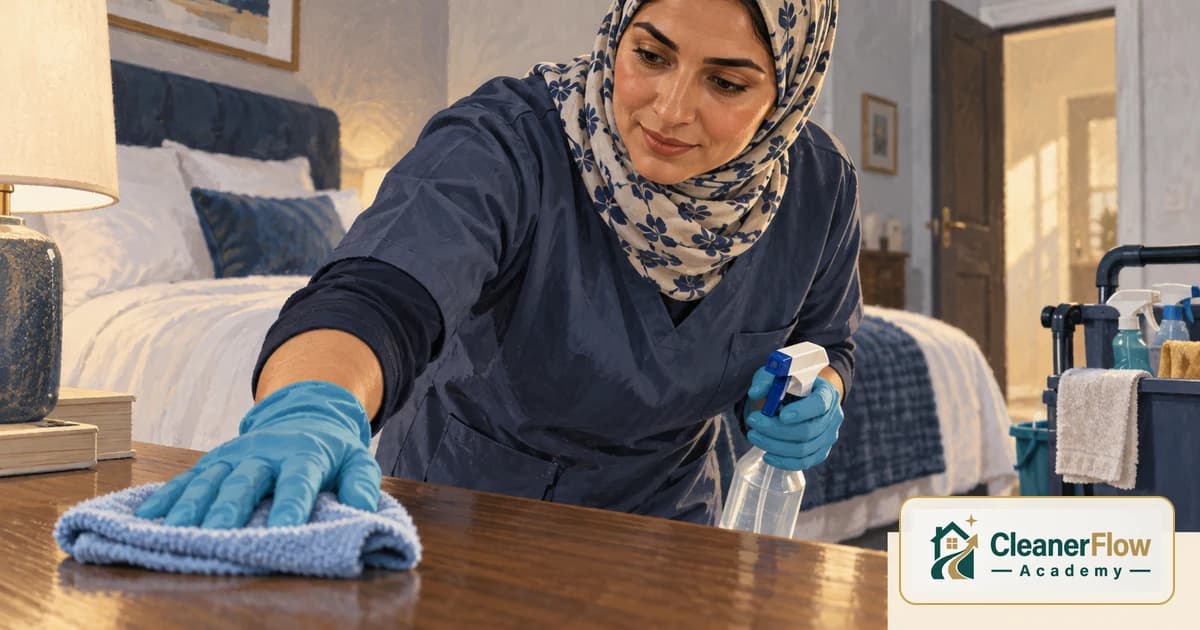
Faster is a skill, not a shortcut
There is a common fear among cleaners that working faster means working worse. It feels like the only way to speed up is to skip steps, rush, and hope the client does not notice. That belief keeps many good cleaners slow, tired, and earning less than they could.
The truth is different. The fastest professional cleaners are usually also the most thorough. They are not rushing. They have simply removed the wasted motion, the backtracking, and the hunting for supplies that eats up most of a slow cleaner's day. Speed, done right, comes from system, not from cutting corners.
When you clean faster without lowering your standard, every hour is worth more. You can serve more clients, or you can go home earlier with the same income. Either way, learning to work efficiently is one of the most valuable skills in this trade, and it is entirely learnable.
Where the time actually goes
Before you can get faster, you have to understand where a slow cleaner loses time. It is rarely the actual cleaning. It is everything around it.
The biggest thief is walking back and forth. Cleaning a bathroom, realizing the glass cleaner is in the car, walking out to get it, coming back, then noticing the cloths are in another room. Those trips add up to a large part of the day and produce nothing.
The second thief is re-doing work. Mopping a floor, then dusting a shelf above it and knocking crumbs onto the clean floor, then mopping again. Working in the wrong order forces you to clean the same surface twice.
The third thief is decision-making. Standing in a room wondering what to do next, in what order, with which product. Every pause to think is time lost. A cleaner with a fixed routine never has to decide. Their hands already know the next move.
Fix these three and you get faster without touching your quality at all.
Carry your tools with you
The single biggest speed gain for most cleaners is to stop making trips. Everything you use constantly should travel with you, on your body or in a caddy you carry from room to room.
A cleaning apron or tool belt with pockets for your sprays, a few cloths, a scraper, and a scrub pad means you never leave a room to fetch a basic item. A caddy holds the rest. The vacuum and mop wait in a central spot, but the small tools stay on you.
Stock the caddy the same way every time so your hand reaches for the glass cleaner in the same pocket in every home. When the layout of your tools is identical from job to job, you stop looking and start moving.
Before you begin, do a quick setup pass. Open the blinds or turn on lights so you can see, gather any clutter into piles the client permits you to move, and place your caddy in a central spot. Two minutes of setup saves twenty minutes of chaos.
Work one direction around the room
Inside each room, pick a direction and go around the room once, top to bottom, without doubling back. Most professionals work clockwise or counterclockwise, so they always know where they have been and where they are going.
Start high, dust and wipe from the top surfaces down, and let anything you loosen fall toward the floor, which you clean last. By the time you complete the circle, you are back at the door, the room is done, and you never cleaned the same spot twice.
This single habit, one lap around the room without backtracking, is what separates a smooth thirty-minute room from a scattered fifty-minute one. It also guarantees you do not miss a corner, because you never skip ahead.
Let products do the work while you move
One of the smartest professional techniques is to apply a product and then walk away to do something else while it works. Cleaning products need time to break down grime. If you spray a shower and immediately start scrubbing, you fight the dirt with muscle. If you spray it, then leave to clean the toilet and the sink, and come back, the product has loosened the grime for you and it wipes away with little effort.
Use this everywhere. Spray the oven or the tub first, move on to other tasks, and return. Apply toilet bowl cleaner at the start of the bathroom and let it sit while you clean everything else in the room. You are cleaning two things at once, which is the closest thing to free time you will find.
This is a clear example of faster and better being the same move. The dwell time both speeds you up and produces a cleaner result, because the product does what scrubbing alone cannot.
Two hands, fewer passes
Small physical habits add up over a full day. Learn to use both hands. Wipe with one while you spray with the other. Carry a fresh cloth and a used one so you are never empty-handed. When you dust a shelf of objects, move down the line in one direction rather than picking things up at random.
Wipe with intention, not repetition. A common slow habit is wiping the same spot many times out of nervousness. A clean surface with the right product needs one firm, complete pass, not ten light ones. Trust the pass and move on.
Fold your cloths into quarters. A folded cloth gives you eight clean surfaces before you need a fresh one, instead of bunching it into a ball and using the same dirty patch over and over.
A fixed order for the whole home
Just as you work one lap around a room, you should work a fixed route through the whole home. Wandering from room to room without a plan wastes time and makes it easy to forget a space. Professionals follow the same path every time.
A common and effective order is to start the bathrooms and kitchen first by applying products that need to sit, then clean the bedrooms and living areas while those products work, then return to finish the kitchen and bathrooms, and save all the floors for last, working your way toward the exit so you never walk across a floor you just cleaned.
When the route is fixed, you stop deciding and start flowing. You also stop forgetting rooms, because the path always covers the whole house in the same sequence.
What cutting corners really costs
It is worth being honest about the temptation to cut corners, because the math does not favor it. Skipping the baseboards or the inside of the microwave might save five minutes today. But a client who finds the missed spot loses trust, and a client who loses trust does not rebook. Replacing a lost recurring client costs far more time and effort than the five minutes you saved.
Here is an illustrative example. Suppose a recurring client is worth a steady spot on your calendar every two weeks. If skipping small tasks to save a few minutes causes that client to cancel after two months, you have traded a long, reliable relationship for a handful of saved minutes. The efficient cleaner protects the recurring client by being both fast and complete, because that is what keeps the calendar full and the income steady.
Speed should come from removing waste, never from removing work the client is paying for. That is the line, and holding it is what makes you a professional rather than a corner-cutter.
Track your own times
To get faster, measure yourself. Note how long a standard home takes you today. As you apply these habits, watch the number come down while your quality holds or improves. Seeing your own progress is motivating, and it helps you quote jobs accurately, because you truly know how long your work takes.
Most cleaners who adopt a real system find they save a meaningful amount of time on every home within a few weeks, without any drop in results. That saved time is yours to spend on more clients or on rest.
Prepare the night before
Some of the fastest cleaners win time before the day even begins. Restocking your caddy, refilling your spray bottles, washing and drying your cloths, and loading your car the night before means you start each job ready instead of scrambling. Arriving at a home only to find an empty bottle or a bag of damp cloths costs you time and composure at the worst possible moment. A few minutes of preparation in the evening turns every morning into a clean start, and a calm start makes the whole day faster.
Efficiency is professionalism
Working quickly and thoroughly at the same time is one of the clearest signs of a skilled professional. It reflects planning, discipline, and mastery of a repeatable method, exactly the kind of competence a certification like CleanerFlow Academy is designed to recognize. It is not about hurrying. It is about knowing your craft so well that good work flows without wasted motion.
Build your system one habit at a time. Carry your tools, work one lap per room, let products dwell, follow a fixed route, and protect every task the client is paying for. Do that, and you will finish sooner, tire less, and deliver work you are proud of, all at once.
You already clean well. Now you can prove it.
The 7 modules are free. The certificate, with a QR your client checks on the spot, proves what you already know how to do.
Other CleanerFlow apps
Your whole week in one place.
Homes, notes for every client, and who already paid, on your phone — even offline.
Cleaning jobs in your ZIP. See the quality score before you pay.
Every lead goes to 3 cleaners at most, and you get 14 days to dispute a dud.