
How to Look Professional on the First Visit
The first visit sets the tone for the whole relationship. Here are the simple, concrete things that make a client see you as a real professional from the moment you arrive.
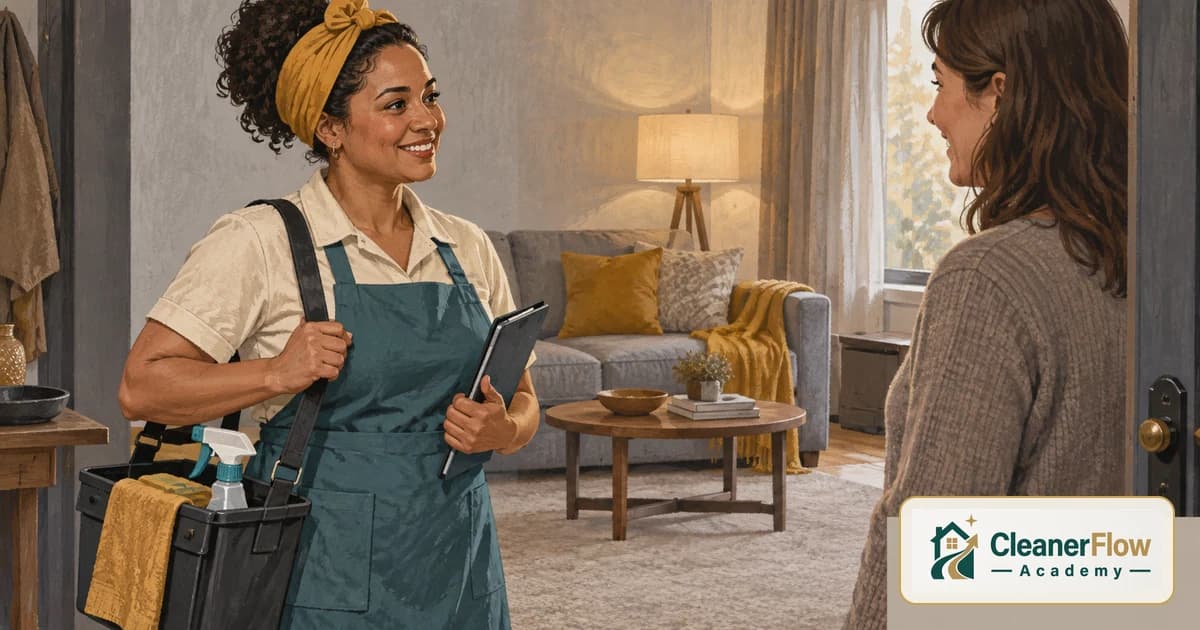
The first visit decides more than you think
The first time you show up at a client's home, a lot is being decided in a very short window. Before you have wiped a single surface, the client is forming an impression of who you are and whether they made the right choice. You already know this from your own life: you judge a stranger at the door within seconds, and so does your client. That impression tends to stick. Get it right, and everything afterward is easier. Get it wrong, and you spend weeks trying to recover from a shaky start.
The good news is that looking professional on the first visit is not about being fancy or expensive. It is about a handful of simple, concrete things anyone can do. This article walks through them in the order they actually happen, from the days before the visit to the moment you say goodbye, so that from the second you arrive, the client sees a real professional at their door.
Prepare before you leave home
Professionalism starts before the visit, not at the front step. The night before, or the morning of, take five minutes to get ready so nothing catches you off guard.
- Confirm the address, the time, and how you will get in. Is the client home, or is there a key, a lockbox, or a code?
- Reread any notes from your first conversation. Did they mention pets, a baby napping, a room they do not want touched, a product they are allergic to?
- Check your supplies the night before, not in the car. Restock what is low and make sure everything is clean.
- Plan to arrive with time to spare, allowing for traffic and parking.
A cleaner who walks in already knowing the client's name, their dog's name, and the one thing they care most about looks like a professional because they are behaving like one. This small habit separates you from someone who improvises.
Arrive on time, every time
Nothing signals professionalism faster than being on time. It is the very first promise you make to a client, and keeping it tells them, before you say a word, that you are reliable. If you said nine o'clock, being there at nine o'clock speaks volumes about the kind of professional you are.
Aim to arrive a few minutes early and simply wait nearby, rather than rushing in late and flustered. Arriving calm and on time lets you start the visit composed, which sets the whole tone. Do not knock fifteen minutes early either, because that can feel intrusive to a client who is still getting ready. On time means on time.
If something truly unavoidable makes you late, let the client know as early as you can, and give them a real new time rather than a vague one. A professional who says "traffic is heavy, I will be there at 9:15" is very different, in the client's eyes, from one who simply shows up late with no word. Communication turns a problem into a sign of responsibility.
Look clean, tidy, and put-together
You do not need special clothing or anything expensive. You need to look clean, neat, and cared-for. A client reads your appearance in the first few seconds, and they read it as a preview of how you will treat their home. Someone who looks tidy signals that they pay attention to detail, which is exactly what a client hopes for in a cleaner.
Wear clean, practical clothes suited to the work: comfortable, closed shoes, nothing torn or stained, hair tied back if that is practical for you. A simple shirt in one color always reads as put-together. If you ever want to look a step more professional, a plain apron or a shirt with your name or business name on it is an easy, inexpensive touch. The message you want to send is simple: this is a person who takes care, and by extension will take care of my home. This is one of the easiest professional signals to send, because it costs almost nothing and depends only on a little attention before you walk out your door.
Bring organized, well-kept supplies
Your tools speak for you. When you arrive with your supplies organized and in good condition, it tells the client you are prepared and serious. When your things look chaotic or worn out, it plants a small doubt, even if the client cannot say why.
You do not need the newest or most expensive equipment. You need it clean and orderly. A single sturdy caddy or a tidy bag where each product has its place shows that you approach your work with method, not by improvising. Wipe down your bottles so they are not sticky, keep cloths folded and clean, and empty your vacuum before you arrive rather than in front of the client. That impression of order carries over in the client's mind to how you will clean their home. A professional who is organized with their own tools is trusted to be organized with someone's space.
Greet the client warmly and calmly
How you carry yourself in the first minute matters enormously. A warm, calm, respectful greeting immediately signals a professional who is comfortable and secure. You do not need to be chatty or perform. You just need to be friendly, steady, and respectful.
Make eye contact, greet them warmly, and be polite. Say your name clearly, even if you have spoken on the phone. Speak calmly rather than nervously. If the client wants to walk you through the home or explain what they need, listen carefully and attentively, and it is fine to repeat the key points back to them so they know you understood: "So the kitchen and both bathrooms are the priority, and you would rather I leave the office alone. Got it." Listening well is itself a powerful professional signal, because it tells the client you care about getting things right for them specifically, not just doing a generic job. A professional who listens is a professional who will get the details right.
Show that you are a certified professional
The first visit is the perfect moment to let a client know you are certified, because it is exactly when trust is being decided. Bringing it up naturally, early in the conversation, reframes you from an unknown to a professional before the client has settled their impression.
You can mention it simply, something like letting them know you are a certified house cleaner through CleanerFlow Academy, a trilingual certification for house cleaners in the United States, and that you are happy to show them the certificate. Offering to show it, rather than pushing it, signals quiet confidence. And if it can be verified, for example by scanning a code, letting the client know they can confirm it is real turns your professionalism from a claim into something they can check. Few things build first-visit trust faster than proof a nervous client can verify with their own phone.
Describe it honestly, because accuracy is what makes it credible. The certification confirms the professional standard you already hold; it validates the real skill you bring, rather than teaching you to clean. It is a private certificate issued by CleanerFlow, not a government license, not an official accreditation, and not a promise of any particular income or number of clients. Said plainly and truthfully, it lands as exactly what it is: solid, real proof that you take the profession seriously. Overstating it would only backfire the moment a client looked closely, so let the plain truth do the work.
Be clear and honest about the work
A big part of looking professional is how you talk about the job itself. Be clear about what you will do, how you work, and what the client can expect. Clarity reassures. Vagueness worries. When you explain things plainly and confidently, the client relaxes, because they feel they are dealing with someone who knows their craft.
Equally important is honesty. If something cannot be done in the time booked, or will take longer, or is outside what you offer, say so plainly and kindly. If a stain may not come out fully, tell them before you start rather than after. Clients trust honesty far more than they trust someone who promises everything. Overpromising on the first visit almost always backfires, because it sets expectations you then fail to meet. A professional who is straight with a client from the start builds a foundation that lasts.
Respect the home from the very first step
Professionalism is also in the small courtesies. From the moment you enter, treat the home with visible respect. Follow whatever the client asks, whether that is about shoes, certain rooms, pets, or anything else. Handle their belongings gently, and put things back exactly where you found them. Ask before doing anything you are unsure about rather than guessing, especially with delicate surfaces or items that look valuable.
These small acts of respect tell the client, more than any words, that their home is safe in your hands. On a first visit especially, a client is watching closely for exactly these signals, because they are trying to learn what kind of person they have let in. Every small courtesy answers their unspoken question with a quiet yes, this person respects my space.
Work safely and carefully
Looking professional is not only about appearances. It is also about how carefully you work. On the first visit, the client may be watching, and even when they are not, the results reveal how you handled their home. Working safely and carefully protects both the home and your reputation.
That means following safe practices without fail: never mixing cleaning chemicals, because some combinations create dangerous fumes, always following the label on each product, opening a window when using strong products, and treating each surface with the right approach so nothing is damaged. Test an unfamiliar product on a small hidden spot before using it widely. A client who sees careful, knowledgeable work concludes they hired a real professional. Carelessness, even once, on a first visit can undo every other good signal you sent, so let your care match your presentation.
Avoid the common first-visit mistakes
Even skilled cleaners lose good clients over avoidable slips. Watch out for these:
- Arriving late with no message, which reads as unreliable before you have started.
- Talking too much or checking your phone, which makes a client feel like a low priority.
- Promising more than the time allows, then leaving with the job half done.
- Guessing instead of asking, and damaging a surface or moving something the client wanted left alone.
- Rushing out the door without a word about how it went.
Before you leave, take a moment to walk the client through what you did, mention anything they should know, and thank them. A calm, confident goodbye is as important as the greeting, because it is the last impression they carry until next time.
The bigger picture
Looking professional on the first visit comes down to a set of simple, doable things: prepare beforehand, arrive on time, look tidy, bring organized supplies, greet the client warmly, show that you are certified, speak clearly and honestly, respect the home, work safely, and close well. None of these require money or special talent. They require intention. And together they tell the client, from the very first minute, that they made the right choice.
That strong first impression is the start of a lasting relationship, and lasting clients are the foundation of a stable cleaning business. If you want the single strongest addition to your first-visit impression, get certified through CleanerFlow Academy, so you have real, verifiable proof to offer exactly when trust is being decided. And as your business grows, running like a full professional also means a steady schedule, a reliable flow of clients, and simple tools to stay organized, which is the ecosystem CleanerFlow is building for cleaners. But it all begins at the door, in those first few minutes, when a client looks at you and decides they are in good hands.
You already clean well. Now you can prove it.
The 7 modules are free. The certificate, with a QR your client checks on the spot, proves what you already know how to do.
Other CleanerFlow apps
Your whole week in one place.
Homes, notes for every client, and who already paid, on your phone — even offline.
Cleaning jobs in your ZIP. See the quality score before you pay.
Every lead goes to 3 cleaners at most, and you get 14 days to dispute a dud.